


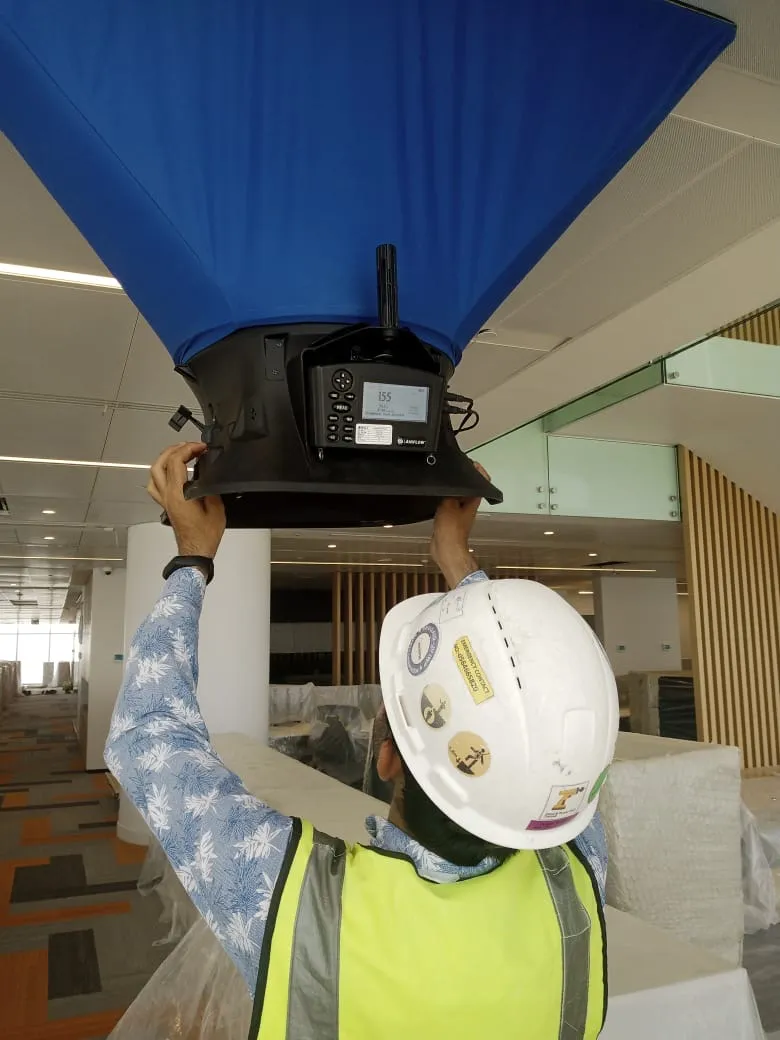
What HVAC TAB Actually Covers on Site
Testing, Adjusting and Balancing (TAB) is the third-party field verification process performed after mechanical installation is complete and before project handover. Its purpose is straightforward: measure the actual air and water flow rates across the installed HVAC system, adjust dampers and balancing valves iteratively, and bring every terminal unit and branch within the tolerances specified on the approved mechanical drawings.
Without proportional balancing, air and chilled water follow the path of least resistance. Terminals closest to the fan or pump receive excess flow, while index runs at the end of long duct or pipe branches remain starved—leading to hot spots during peak Saudi summer conditions, room pressurization issues, and wasted fan and pump energy.
Air-Side System Verification
Covers main supply, return, and fresh-air duct Pitot traverses alongside terminal diffuser, grille, VAV box, and exhaust register balancing using calibrated capture hoods.
Hydronic Chilled Water Balancing
Covers primary and secondary chilled water pumps, main header flow verification, and proportional adjustment of Double Regulating Valves (DRVs) and Pressure Independent Control Valves (PICVs).
Pre-TAB Site Readiness Checklist
Field balancing can only produce accurate, repeatable results when the mechanical and electrical installation is genuinely ready. Before a TAB team mobilizes to a project site in Al Khobar, Riyadh, Dammam, or Jubail, the following readiness criteria should be verified:
Ductwork, Dampers & Terminal Completion
All supply, return, and exhaust ductwork must be complete, sealed, insulated, and fitted with accessible manual volume control dampers (VCDs) at branches and terminal necks, with false ceilings closed where pressurization applies.
Electrical & Mechanical Equipment Start-Up
Air handling units (AHUs), fan coil units (FCUs), packaged rooftop units, and extract fans must be permanently energized, running in the correct rotation, and fitted with clean commissioning filters.
Flushed & Vented Hydronic Loops
Chilled water piping loops must be chemically flushed, strainers cleaned of construction debris, high-point air vents bled, and commissioning valve test ports accessible.
Field Execution: Proportional Air and Hydronic Balancing
The field team begins by reviewing the approved IFC or shop drawings and equipment schedules to prepare zone-by-zone test sheets. Total system airflow is first checked via Pitot-tube duct traverses and fan static pressure/amperage readings at the main AHU or fan.
Main Duct Pitot-Tube Traverse
Velocity pressure readings are taken across a grid of drilled test holes in straight duct sections to establish true total fan CFM/Lps prior to terminal adjustments.
Proportional Terminal Ratio Balancing
Instead of throttling dampers randomly, engineers balance the lowest-percentage (index) outlet on each branch first and lock terminal dampers in proportion back toward the main riser within ±10% design tolerance.
Differential Pressure & Hydronic Valve Setting
Digital manometers and ultrasonic flow meters are connected to circuit balancing valves across FCUs and AHUs to bring chilled water GPM/Lps into strict alignment with coil schedules.
What to Expect in the Final Certified TAB Report
A complete TAB submittal is a formal engineering record required for supervising consultant approval and project closeout across commercial, healthcare, and industrial projects in Saudi Arabia.
Traceable Instrument Calibration Certificates
Valid laboratory calibration certificates for every flow hood, micro-manometer, Pitot tube, tachometer, clamp meter, and hydronic gauge used on site.
Equipment & Terminal Data Schedules
Nameplate vs. actual running amperage, voltage, fan RPM, external static pressure (ESP), and terminal-by-terminal design vs. initial vs. final balanced readings.
Marked-Up As-Built Test Drawings & Punch List
Schematic or floor-plan drawings identifying every test point and terminal reference number, plus an itemized deficiency log for any site constraints encountered.
Frequently Asked Questions
What tolerance is acceptable for HVAC air and water balancing in Saudi Arabia?
Unless specified tighter by healthcare or cleanroom project specs, commercial and industrial HVAC specifications in Saudi Arabia (aligned with SMACNA and ASHRAE Standard 111) typically require terminal and branch airflows as well as hydronic coil flows to be balanced within ±10% of approved design values.
When during the construction schedule should the TAB contractor be mobilized?
TAB should be scheduled after mechanical ductwork/piping completion, equipment start-up, and ceiling grid installation, but prior to final consultant witness inspections and occupancy handover.
Do you provide calibrated instruments and consultant witness testing?
Yes. Every Shan Testing team deploys with valid laboratory-calibrated digital capture hoods, Pitot tubes, and hydronic manometers, and conducts joint on-site spot checks with the supervising engineering consultant.